Beginner → high score
Starting GMAT? Here’s how to reach 695+ the right way.
Most people waste months figuring things out. I reached 695+ in under three months while working full-time — by following a phased plan, not random hustle. This roadmap lays out that same sequence so you can aim for a similar ~3-month timeline alongside your job.
Already near 600–650 and need a tight final sprint? There’s a separate 16-Day Jump System for that.
Open the 16-Day Jump System → By Akshay Bhardwaj·695+ in under 3 months · while working full-time
Save ₹1,500 · 60% off launch
One-time payment · Instant PDF · 12 months of updates (same policy as the Jump System)
Phases in the PDF align to each band — exit criteria before you pile on volume.
The problem
Why people stall before they even get going
- Too many resources — every new book and course resets your plan.
- No clear roadmap — you study hard without knowing what “done” looks like for each stage.
- Early confusion — small mistakes in the first weeks compound into plateau months later.
Outcomes
What this guide does
- Gives a complete roadmap from first diagnostic → 695+ on a ~3-month arc designed for people with jobs.
- Removes confusion — one phased path instead of ten tabs open at once.
- Provides structured phases so you always know the job of the week.
Inside the PDF
What you’ll get
Step-by-step roadmap
No guesswork — what to prioritize at each stage.
Study phases
Beginner → intermediate → advanced, with clear exit criteria.
Resource strategy
Official Guide, GMAT Club, official mocks — and why each has a role.
Mock strategy
When to test, how to review, how to track real progress.
Working-professional plan
Weekday vs weekend blocks and energy-aware scheduling.
This roadmap is the long arc from the start. When you’re ready to optimize the last stretch, add the 16-Day GMAT Jump PDF.
Explore the 16-Day Jump →This is not a shortcut guide. It’s a structured path to 695+ — one you can realistically run in about three months while employed, if you follow the phases.
Meet the author
Hi, I’m Akshay.

Akshay Bhardwaj
Engineer · Builder · GMAT Focus 695 (16-day improvement)
I’m a full-time engineer and builder - someone who struggled with GMAT just like you.
I’ve spent the last few years shipping things end-to-end: an AI stock analysis platform (MagicStocks.ai) and a D2C brand (Slick Stiles). So I’ve always believed in systems, not shortcuts.
But during my GMAT prep, I got stuck at 645 - despite real effort. I was solving questions, switching resources, doing what everyone else was doing. Nothing moved.
In the final 16 days, I stopped preparing randomly and built a system around how the GMAT actually works. That shift took me to 695 while managing a full-time job.
This guide is simply that system - what worked, what didn’t, and how you can apply it without wasting time, energy, or money.
Introduction
Why 695+ is rare — and how a roadmap fixes it
Most people don’t fail because they lack effort. They fail because no one gave them a sequence: what to build first, when to add timing pressure, and when to stop collecting new material.
My own run to 695+ took under three months end-to-end while I was working full-time. The famous 645 → 695 in 16 days was the final optimization sprint after that foundation — not the whole story. This PDF is the longer arc for people earlier in the journey: the same principles in the order I wish I’d had from Day 1, so you can target a similar ~3-month timeline without quitting your job.
Verify first
Official GMAC score reports
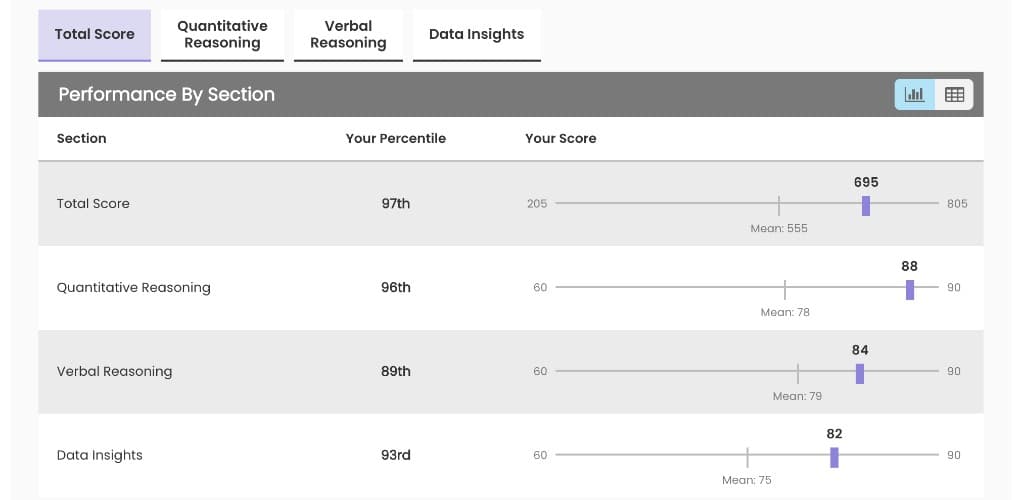
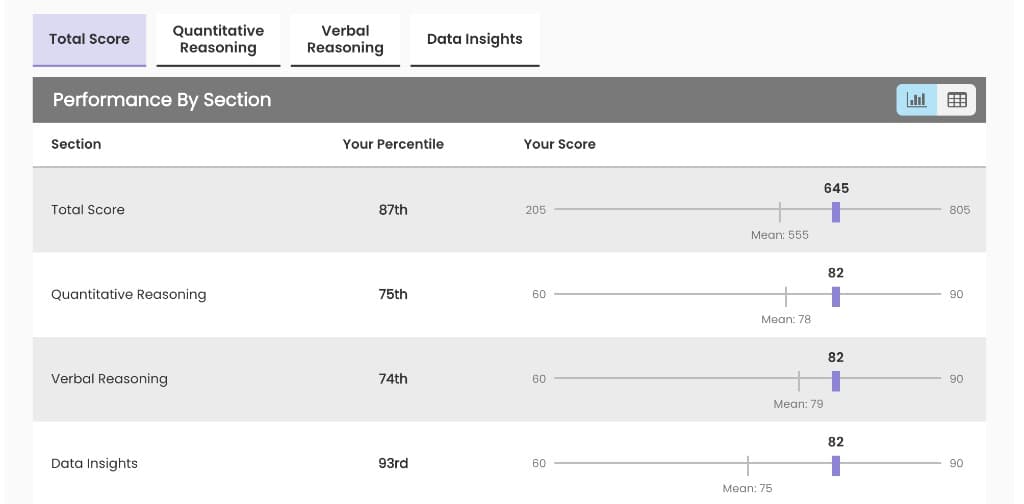
Focus Edition Performance by Section from both attempts - then compare notes on GMAT Club.
Attempt 2 · 16 days later
69597th percentile
Quant 88 (96th) · Verbal 84 (89th) · Data Insights 82 (93rd)
Attempt 1
64587th percentile
Quant 82 (75th) · Verbal 82 (74th) · Data Insights 82 (93rd)
Scores and timeline are on my public GMAT Club profile — verify before you buy.
View my GMAT Club profileWhat GMAT actually tests
- Not memory — you’re not cramming formulas for a trivia test.
- Reasoning + decision-making — especially under time pressure.
- Pattern recognition — seeing structures repeat across Quant, Verbal, and Data Insights.
The 3-phase system
Foundation → Build → Optimize
Phase 1 · Foundation
0 → ~550
Basic concepts, light practice, low pressure.
Phase 2 · Build
550 → 650
Pattern recognition, timed practice, weakness ID.
Phase 3 · Optimize
650 → 695+
Deep analysis, decision-making, exam strategy.
Phase 1 · Foundation
0 → ~550
Basic concepts, light practice, low pressure.
- Build vocabulary for your own mistake language.
- Official material first exposure — quality over volume.
- No mock anxiety yet — you’re building familiarity.
Phase 2 · Build
550 → 650
Pattern recognition, timed practice, weakness ID.
- Timed sets mixed with untimed learning blocks.
- Error log with buckets — not just “I was careless.”
- Official + GMAT Club for explanations, not random PDFs.
Phase 3 · Optimize
650 → 695+
Deep analysis, decision-making, exam strategy.
- Mocks become decision labs — bail, guess, or push?
- Review heavier than the mock itself.
- Rules you can say in one sentence before every section.
Study rhythm (working professionals)
Adjust hours to your job — the shape of the week matters more than identical daily minutes.
| When | Block | Non-negotiable output |
|---|---|---|
| Weekday (medium) | 60–90 min | One weak-topic block + 5 logged mistakes reviewed |
| Weekday (light) | 30–45 min | Read two GC threads + 10 official questions or flash review |
| Saturday | 2–3 h | Timed mixed set or half-mock + same-day review outline |
| Sunday | 2–3 h | Mistake-log surgery + plan next week’s top 3 leaks |
Resource strategy (and why)
Hierarchy: official ground truth → discussion → full mocks
- 1
Official GMAT Guide
Ground truth for question style — everything else is commentary.
- 2
GMAT Club
Discussion, alternate explanations, difficulty filters — after official attempts.
- 3
Official mocks
Calibration and stamina — the only realistic dress rehearsals.
Mock strategy
- When — after Phase 2 has timed practice; not on day one.
- How to review — every miss gets a bucket + one-line rule.
- Track progress — score bands matter less than repeat-trap counts going to zero.
Mock analysis flow
Same loop used in the PDF - with a mistake taxonomy you can reuse
- 1Finish mock
- 2Log every miss
- 3Classify error
- 4One drill block
- 5Re-check concept
High-impact mistakes to avoid
- Doing too much — new resources instead of finishing the loop.
- No system — studying when you feel like it vs a weekly contract.
- Ignoring analysis — more questions with zero taxonomy change.
- Poor timing discipline — practicing untimed forever, then panicking on mocks.
When you’re ready for the sprint
Around **600–650**, volume stops helping and **optimization** wins. That’s when you layer the **16-Day GMAT Jump System** — deep diagnosis, mock loops, and decision rules for the final stretch.
Explore the 16-Day Jump System →695+ rewards systems — not heroics
A high score is the output of repeatable decisions: what you study, how you review, and what you refuse to do when you’re tired.
This roadmap is your map for roughly three months of focused, job-compatible prep. Walk the phases honestly — the exam will still be hard, but you won’t be guessing what “good prep” looks like this week.
FAQ
- Is this for complete beginners?
- Yes — it’s built for people starting out or early in prep who want a single phased path to 695+, without collecting ten courses first.
- How is this different from the 16-Day Jump System?
- The Jump System is a tight sprint for people already near 600–650 who need optimization. This roadmap is the longer arc from the start — the kind of phased plan I followed over **under three months** while working full-time, before that final 16-day push. Many people use this first, then add the Jump for the last stretch.
- Can I really do this in about three months with a job?
- That’s the design: phased work, official-first resources, and a weekly rhythm built for evenings and weekends. Everyone’s baseline differs, but if you run the system consistently, **~3 months** is the realistic target this roadmap is built around — the same ballpark I used while employed.
- Do I need coaching?
- No. The PDF is the system. Coaching is optional if you want accountability later.
- How do I get the PDF after paying?
- Same as the Jump System: Cashfree checkout, then a private buyer area and email with your watermarked download.